

Understanding Bombay Population in 1850s
Looking at 1849 Census and 1855 Gazette data

The British administration in India was a behemoth. They collected detailed data, meticulously and ruthlessly. While the British government is known for having established the decadal census in India beginning in 1881, they initiated local censuses much earlier. The Census of the Islands of Bombay and Colaba in 1849 was one of them. Here’s a quick lesson on how Bombay was formed through land reclamation.
The 1849 Census
The 1849 Census was conducted by Captain Bayne, the Superintendent of Police in Bombay, on the 1st of May, 1849. The enumeration categorized the population based on four factors: the police administrative division, sex, age, and caste (the significance of italicizing 'caste' will become evident shortly). There were seven police administrative divisions: A, B, C, D, E, F, & Water.
It is important to note that the Census did not differentiate between individuals born on the Islands, the mainland, or between permanent citizens and temporary residents.
Below is a summary of the population distribution by age, sex, and administrative division.
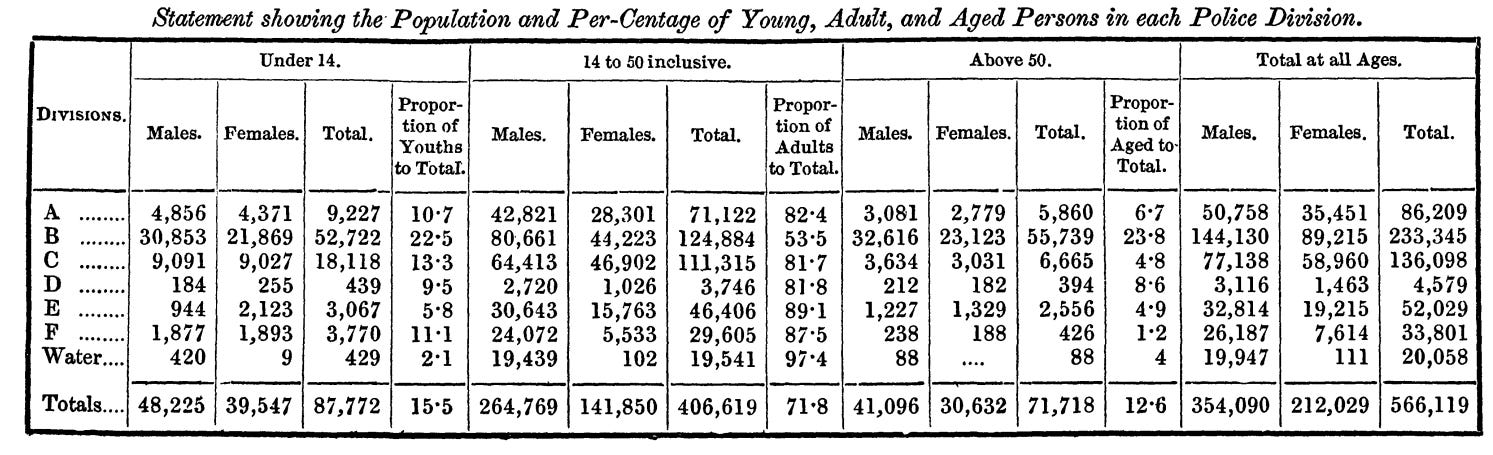
The population of Bombay in 1849 was 566,119, and the sex ratio (number of females per 1000 males) was 599. Colonel Sykes, a statistician and Indologist who reported the Census data, found the sex ratio surprising. In Europe, the female population was known to be greater than that of males. He noted the following potential factors contributing to the imbalance:
Occupational demographics and temporary workers: Many seamen in Bombay harbor and workmen in dockyards and factories were without their wives, and these workmen generally did not bring their families with them. The presence of a large number of adult Hindu sojourners, primarily laborers, contributed to the imbalance as they were still present in large numbers in shipping, dockyards, and public works.
A possible reason could be prejudice against females, practiced in the form of infanticide in many parts of the country. However, Sykes believed that infanticide was not prevalent in Bombay.
Despite these factors, Sykes questioned the accuracy of the census data due to the extreme disproportion observed, suggesting that the actual reasons might be more complex and warranted further investigation.
Religion or Caste?
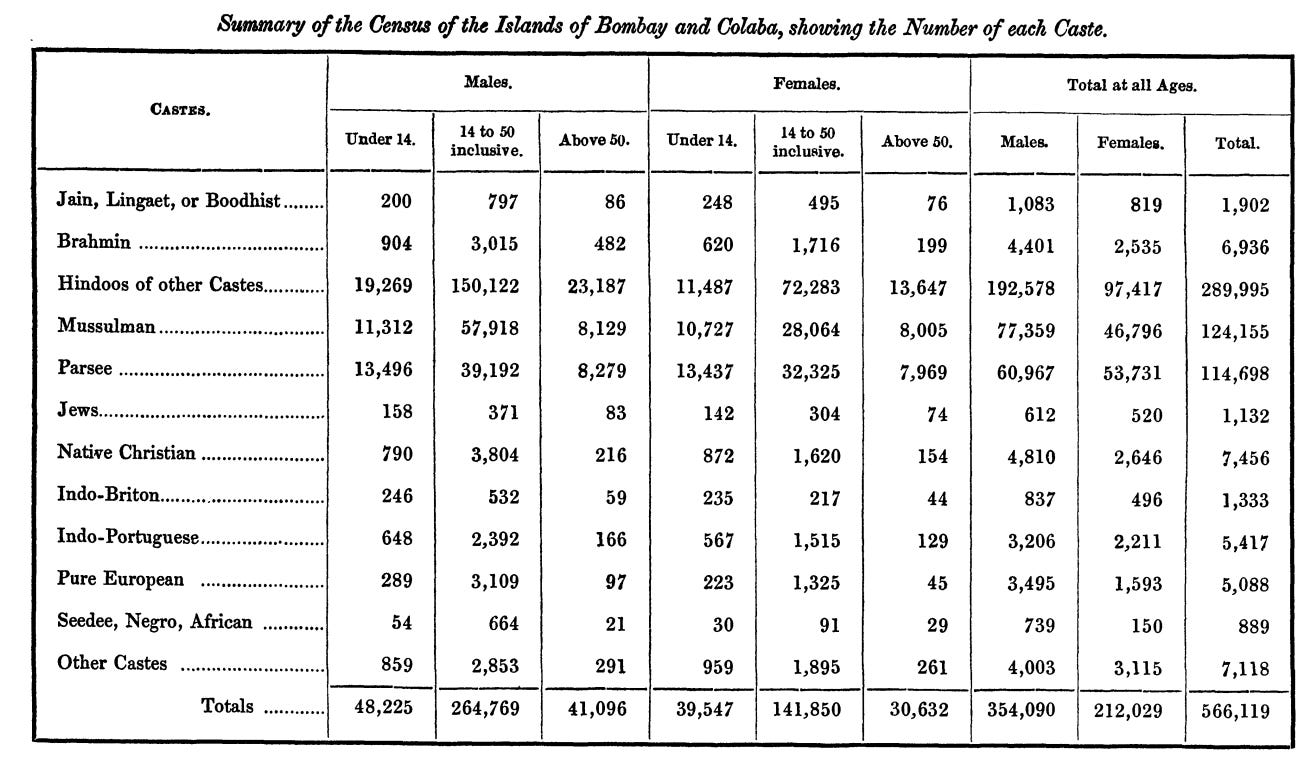
The table above summarizes the population by caste, sex, and age groups. The emphasis on 'caste' here and earlier arises because the categories appear to be a combination of religion and race. However, a clear distinction was made between Brahmins and Hindoos of other Castes.
When Colonel Sykes questioned Captain Bayne about the improper caste division and the incongruous grouping of religions (Jains, Lingayats, and Buddhists), Sykes wrote about Captain Bayne's response:
“that from knowing the different castes, he had hoped to be able to classify them into trades, but that the people in Bombay have broken through the prejudices, so strictly adhered to elsewhere, of children following the occupation of their parents, and he was therefore compelled, after great delay and difficulty, to give up the attempt.”
Colonel Sykes believed that by collecting data on caste, they could have gained better insight into the fundamental changes in society's constitution. He believed that Captain Bayne may have "overestimated the present extent of the reformation."
However, if the data were available, an interesting question could be answered: whether migration to and urbanization in Bombay played a role in breaking caste prejudices that existed elsewhere at the time.
According to the data, Hindus formed the majority of the population, constituting 52.8%, followed by Muslims (21.9%), and Parsis (20.3%).
The percentage of youths (0-14 years) among the Parsi population was 23.4%, 17.7% among Muslims, and 10.8% among Hindus. From this, Sykes inferred,
“Should these results be correct, the excess of Hindoos over Parsees must be very rapidly diminishing, and it may be expected that the latter, at no very distant period, will constitute a majority of the fixed inhabitants of the island”.
This prediction by Sykes would prove to be incorrect, but it would be interesting to examine the factors that could have led to Sykes' anticipated result but did not materialize.
According to the 2011 Census, Hindus constituted 65.9% of the population, Muslims constituted 20.65%. The Parsi population, which was 114,698 in 1955, would be no more than 50,000 in 2011.
Wealth Inequality in British India
The Gazette also published a list of people qualified to be Jurors in the Supreme Court of Bombay. The qualifying factor was whether the person owned a House of the Annual Value of Rs. 300 (1855 prices). It should be noted that the juror population data corresponds to the year 1855, which was the best available information, while the adult male population data is from the census year of 1849. I am assuming here that the population does not significantly change in this 6 year period.
This information provides a quick way to measure the relative wealth of people of each religion during that time. The following chart plots the relative proportions of members of each religion in the juror population and the adult male population in Bombay.
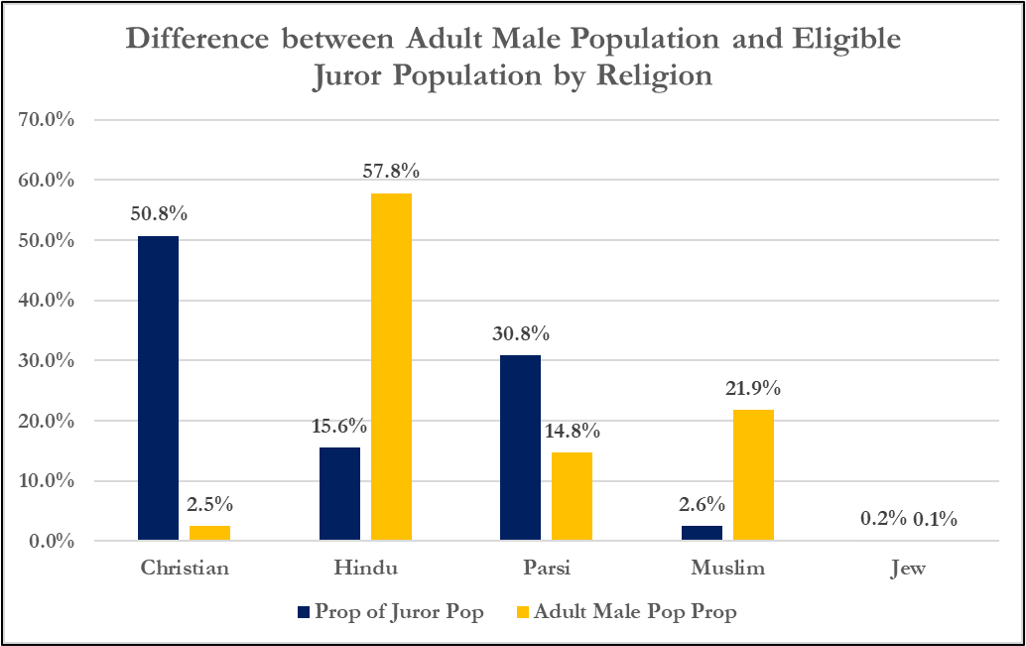
For Christians and Parsis, their proportions among jurors were higher than their population, indicating their relatively greater wealth compared to Hindus and Muslims during that period. The numbers reflect the extent of this disparity: 7.0% of Christians were qualified to be jurors based on the home ownership factor, and the respective numbers for other religions were: Hindu (0.1%), Parsi (0.7%), Muslim (0.0%), and Jews (0.5%). There is no indication that any Jain, Lingayat, or Buddhist was qualified to be a juror based on the house ownership characteristic.
References:
3 May 1855 List of Jurors from the Supplement to the Bombay Government Gazette
Sykes, C. (1852). On the Census of the Islands of Bombay and Colaba, Taken on the 1st of May, 1849, by Captain Baynes, Superintendent of Police. Journal of the Statistical Society, 15(4), 327. https://doi.org/10.2307/2979630
Addendum
Here’s an extended footnote reproduced in full from Sykes’ presentation of the Census data:
Some of the constituents of the population are very peculiar, and have a high historical interest. The Parsees, for instance, numbering 114,698, the most industrious, enterprising, educated, intelligent, and wealthy of the inhabitants, are the descendants of the ancient fire-worshippers of Persia, who expatriated themselves at the period of the spread of Mahomedanism, and are believed to have landed in India, near to Bulsar, in the northern Konkun. They have preserved, to this day, the physical characteristics, complexion, religion, and usages, of their forefathers, and, strange to say, notwithstanding the spread of European knowledge amongst them, and the great proficiency of very many in European literature, science, and art, they continue the superstitious usages of exposing their dead on the tops of towers to be devoured by the fowls of the air, of worshipping fire, and of practising their worship with puerile and absurd ceremonials.
The Jews of Bombay, also, are not less objects of historic interest than the Parsees; they amount to 1,132, and they and their more numerous co-religionists on the Malabar coast, are probably descended from the ten tribes of the first captivity, and escaped from the cruel oppressions of their Assyrian masters to India. With rare exceptions, they are as black as the natives of the country, but have somewhat of the Jewish countenance. They possess parts of the Bible, and read it in Hebrew. They enlist in the regular native regiments, and many of them are acquainted with reading, writing, and cyphering; they make smart non-commissioned officers, and frequently obtain commissions as native officers. In support of the belief of these Jews belonging to the tribes of Israel, and, therefore, to the first captivity, rather than to those of Judah and the second captivity, they all have the affix of Israel to their names, such as Daodjee (David) Israel, Sullimanjee (Solomon) Israel, Maosjee (Moses) Israel, Benjaminjee (Benjamin) Israel, &c. Recently a colony of Jews has been found at Kai-fung-foo, in Honan, in China, 600 miles from Shangai, who consider that they came originally from India, and they, too, call themselves Israelites. Although possessed of the Hebrew Pentateuch and Hebrew Liturgies, they have forgotten the Hebrew language; but two of them eagerly accepted an invitation of the English missionaries at Shangai to be taught Hebrew;—these, also, may be a fragment of the ten tribes.
Another curious portion of the inhabitants of Bombay is the Lingaet Hindoos, improperly classed with the Jains and Boodhists, who are not Hindoos. They are followers of Siva, but repudiate Brahminism, and exclusively worship the Phallus, which emblem they suspend round the neck or attach to the arm, in a silver case. They originated with Bassava in the 12th century.
The Jains are an heterodox offshoot from the Boodhists, whose religion pervaded all India from the 6th century before Christ, until the 7th or 8th century after. The Juttees, or Sacerdotals, are characterised by their extreme regard for animal life, and wear a gauze veil over the mouth for fear they should swallow an insect, and carry a fan in their hands to fan away insects from the ground before they sit upon it. They do not wear a covering on the head, nor shave it, but crop the hair short like a European; and their white robe, worn like a Roman toga, and their solemn stately gait, give them an air of great dignity. With respect to the other constituents of the population of Bombay, for its narrow area, probably it exhibits a more heterogenous mixture than any other spot on the globe.
Very very interesting to contrast with the present situation in Mumbai! Esp loved to see migration impacting gender composition way back then. Look forward to your posts, so varied and always interesting!!